There’s something almost supernatural about your first glimpse of the Isle of Skye. As you cross the bridge from the Scottish mainland or emerge from the ferry onto its shores, you’re immediately struck by the feeling that you’ve stepped into another world entirely. This isn’t just another Scottish island. It’s a place where jagged mountain peaks thrust skyward like the spines of sleeping dragons, and where every turn in the road reveals a landscape so breathtaking it borders on the ridiculous.
The locals call it “An t-Eilean Sgitheanach”—The Winged Isle—and after spending time here, you’ll understand why. Skye doesn’t just sit in the Inner Hebrides, it soars above them. Its dramatic ridgelines and otherworldly rock formations creating silhouettes against the sky that look like they were sketched by someone who had never seen a normal mountain and decided to improvise. This is an island that has been shaped by fire and ice, by millions of years of volcanic fury and glacial patience, creating a geological masterpiece.
But Skye isn’t just about jaw-dropping scenery—though there’s certainly plenty of that. It’s about the intangible magic that seems to seep from every loch and glen, the way ancient Gaelic legends feel not just possible but probable when you’re standing in the shadow of the Old Man of Storr or gazing across the ethereal waters of the Fairy Pools. It’s about discovering that some places on earth still exist that can make you feel genuinely small in the best possible way.
The Quiraing: A Landscape from Another World
The Quiraing stands as one of the most photographed locations in Scotland, and for good reason. This otherworldly landscape creates a dramatic tableau of towering rock pinnacles, hidden plateaus, and sweeping vistas that seem to belong in a fantasy film. The area’s name derives from the Gaelic “Cuith-Raing,” meaning “round fold,” referring to the hidden sanctuary where local crofters once hid their cattle from raiders.
The Quiraing Loop Walk offers visitors multiple viewpoints and experiences within this geological wonderland. The Needle, a towering rock spire, serves as the area’s most iconic landmark, while the Prison creates a natural amphitheater surrounded by vertical cliff faces. The Table, a flat-topped grass plateau, provides one of Skye’s most surreal picnic spots, accessible only by scrambling through narrow gaps between the rocks.
Walking Time: 2-3 hours for the full circuit.
Difficulty: Moderate (some steep sections and uneven terrain).
Best Time: Early morning or late afternoon for optimal lighting.
Parking: Free parking at the Quiraing car park (can be crowded in summer).
Photography Tip: The changing light throughout the day creates completely different moods and colors.
Old Man of Storr: Skye’s Most Iconic Landmark
The Old Man of Storr rises 50 meters from the ground like a stone giant guarding the island’s secrets. This dramatic rock pinnacle was created by an ancient landslide that left behind this spectacular collection of rocky pinnacles and towers. The formation appears on countless postcards, calendars, and travel brochures, making it perhaps the most recognized natural landmark in Scotland.
The hike to the Old Man begins from the car park on the A855 and follows a well-maintained path that gradually ascends through moorland and rocky terrain. The closer you get to the formation, the more impressive it becomes. The sanctuary behind the Old Man offers a hidden world of smaller rock formations and provides excellent opportunities for exploration and photography.
Walking Time: 45 minutes to 1 hour each way.
Difficulty: Moderate (steep initial climb but then easier terrain).
Height Gain: Approximately 180 meters.
Best Views: From the hill behind the Old Man for panoramic shots.
Crowds: Very popular so visit early morning or late afternoon to avoid peak times.
Fairy Pools: Nature’s Crystal Clear Paradise
The Fairy Pools of Glen Brittle have become one of Skye’s most beloved attractions, drawing visitors to witness their ethereal beauty. These series of crystal-clear pools and waterfalls create a magical landscape that seems to validate their enchanting name. The pools’ clarity is so remarkable that you can see every detail of the rocky bottom, even in the deepest sections.
The main waterfall drops into the largest pool, creating a natural swimming hole for the brave souls willing to face the typically cold Highland waters. The series of smaller pools upstream offer more intimate settings, each with its own character and charm. The water’s blue-green hue changes throughout the day as light filters through the Scottish sky, creating an ever-changing natural light show.
Walking Time: 20-30 minutes each way to the main pools.
Difficulty: Easy (well-maintained path with some rocky sections).
Swimming: Possible but very cold, also in summer.
Best Time: Morning light creates the most magical atmosphere.
Parking: Free parking area (so it can fill up quickly in summer).
Dunvegan Castle: Scotland’s Oldest Continuously Inhabited Castle
Dunvegan Castle holds the distinction of being Scotland’s oldest continuously inhabited castle, serving as the ancestral home of the Chiefs of Clan MacLeod for over 800 years. This impressive fortress, perched on a rocky outcrop overlooking Loch Dunvegan, offers visitors a fascinating journey through Scottish clan history and Highland culture.
The castle’s Great Hall displays an impressive collection of clan artifacts. The Rory Mor’s Horn, a massive drinking horn that clan chiefs must drain in one draught to prove their worthiness, demonstrates the castle’s connection to ancient Highland traditions.
The castle gardens span five acres and feature exotic plants that thrive in the Gulf Stream’s warming influence. The formal gardens include a water garden with ornamental ponds and bridges, while the woodland walks provide peaceful strolls through native Scottish flora. The seal boat trips from the castle’s jetty offer visitors the chance to see Atlantic grey seals in their natural habitat.
Opening Hours: Daily 10:00 AM – 5:30 PM (March-October).
Admission: Adults £15; Children (5-15) £9; Concessions £13.
Garden Only: Adults £12; Children £7.
Seal Boat Trips: Adults £8; Children £6 (weather permitting).
Duration: Allow 2-3 hours for castle, gardens, and boat trip.
Neist Point: Scotland’s Most Westerly Point
Neist Point extends into the Atlantic Ocean like a dramatic finger pointing toward the Outer Hebrides, offering visitors some of the most spectacular coastal scenery in Scotland. This rugged headland, with its distinctive lighthouse perched on the clifftop, provides breathtaking views of the surrounding sea stacks, dramatic cliffs, and endless ocean horizons.
The lighthouse walk follows a steep path down to the point, where the small white lighthouse has guided ships safely through these treacherous waters. The cliff-top views reveal the full drama of Skye’s western coastline, with vertical drops into the churning Atlantic below. On clear days, visitors can see the Outer Hebrides floating on the horizon like distant islands of mystery.
Walking Time: 20-30 minutes each way (steep descent and ascent).
Difficulty: Moderate. Steep path can be slippery when wet.
Best Time: 1-2 hours before sunset for golden hour photography.
Parking: Limited parking at the end of a single-track road.
Safety: Stay well back from cliff edges; weather can change rapidly.
Eilean Donan Castle: Scotland’s Most Photographed Castle
Though technically not on Skye itself, Eilean Donan Castle sits at the gateway to the island and ranks among Scotland’s most iconic and photographed castles. This 13th-century fortress, dramatically positioned on a small tidal island where three sea lochs meet, creates one of the most romantic and recognizable images in all of Scotland.
The castle’s stone bridge connects the island to the mainland, creating the perfect foreground for photographers capturing this architectural masterpiece. The restored interiors showcase period furniture, weaponry, and clan artifacts that bring Scottish history to life. The Banqueting Hall with its impressive fireplace and wooden beams, demonstrates how Highland chiefs lived and entertained their guests.
Opening Hours: Daily 10:00 AM – 6:00 PM (March-October); 10:00 AM – 4:00 PM (November-February).
Admission: Adults £10; Children (5-15) £6; Concessions £8.50.
Location: Dornie village, about 8 miles from Skye Bridge.
Photography: Best shots from the small hill opposite the castle.
Film Connection: Featured in movies including “Highlander” and James Bond films.
Talisker Distillery: Scotland’s Island Single Malt
Talisker Distillery, Skye’s only single malt whisky distillery, offers visitors the chance to taste the island’s liquid gold while learning about the traditional craft of whisky making. This distillery produces a distinctive maritime whisky that captures the essence of Skye’s rugged coastal environment in every sip.
The distillery tours guide visitors through the traditional whisky-making process, from malting and mashing to fermentation and distillation. The tasting sessions allow visitors to sample different expressions of Talisker.
Opening Hours: Daily 10:00 AM – 5:00 PM (March-October); 10:00 AM – 4:00 PM (November-February).
Tours: Essential Classic Tour £12; Tasting Tours £20-£45.
Duration: 45 minutes to 1.5 hours depending on tour chosen.
Booking: Advanced booking recommended, especially in summer.
Age Restrictions: 18+ for whisky tasting; under 18s welcome on distillery tours.
Kilt Rock and Mealt Falls: Geological Wonders
Kilt Rock earned its name from the distinctive pleated appearance of its columnar basalt cliffs, which resemble the pleats of a traditional Scottish kilt. This 90-meter-high cliff face, formed by ancient volcanic activity, creates one of Skye’s most dramatic coastal viewpoints. The Mealt Falls cascade over the cliff edge, creating a spectacular 60-meter waterfall that plunges directly into the sea below.
The viewing platform provides safe access to panoramic views of the coastline, with the Sound of Raasay stretching toward the Scottish mainland. The geological formations tell the story of Skye’s volcanic origins, with different layers of rock representing different periods of volcanic activity.
Viewing Time: 15-30 minutes.
Difficulty: Easy (short walk from car park to viewing platform).
Best Photography: Mid-morning to early afternoon for optimal lighting.
Parking: Free parking with facilities.
Safety: Viewing platform provides safe vantage point but do not venture beyond barriers.
Coral Beach: Skye’s Hidden Tropical Paradise
Coral Beach near Dunvegan offers visitors a surprising tropical-like experience in the Scottish Highlands. This unique beach, composed entirely of bleached coral fragments (actually coralline algae), creates brilliant white sand that contrasts dramatically with the turquoise waters of Loch Dunvegan. The beach provides a surreal experience that feels more Caribbean than Scottish.
The walk to the beach follows a scenic coastal path across moorland and rocky terrain, passing traditional crofting settlements and offering glimpses of the beach’s brilliant white sands in the distance. The beach itself stretches for several hundred meters, providing plenty of space for exploration and relaxation. The sheltered location within the loch creates calmer waters than many of Skye’s exposed beaches.
Walking Time: 30-45 minutes each way.
Difficulty: Easy to moderate (mostly flat with some uneven terrain).
Best Time: Low tide for maximum beach exposure.
Parking: Limited parking at Claigan (follow signs carefully).
Swimming: Possible but cold although water is warmer than ocean beaches.
Sligachan: Gateway to the Cuillin Mountains
Sligachan serves as the gateway to the mighty Cuillin Mountains, offering visitors their first close encounter with these dramatic peaks that dominate Skye’s landscape. The Sligachan Hotel, a historic mountaineering base, sits at the foot of the mountains and has welcomed climbers and hikers for over 150 years.
The Old Bridge at Sligachan provides one of the most photographed views of the Cuillin Mountains, with the Red Cuillin and Black Cuillin creating a dramatic backdrop for the historic stone bridge. Legend claims that dipping your face in the waters beneath the bridge will grant you eternal beauty.
Photography Opportunities: Classic mountain reflections in the river.
Hiking Options: Various walks from gentle strolls to challenging mountain routes.
Facilities: Historic hotel with bar, restaurant, and accommodation.
Geology: Excellent example of different rock types (granite Red Cuillin vs. gabbro Black Cuillin).
Portree: Skye’s Colorful Capital
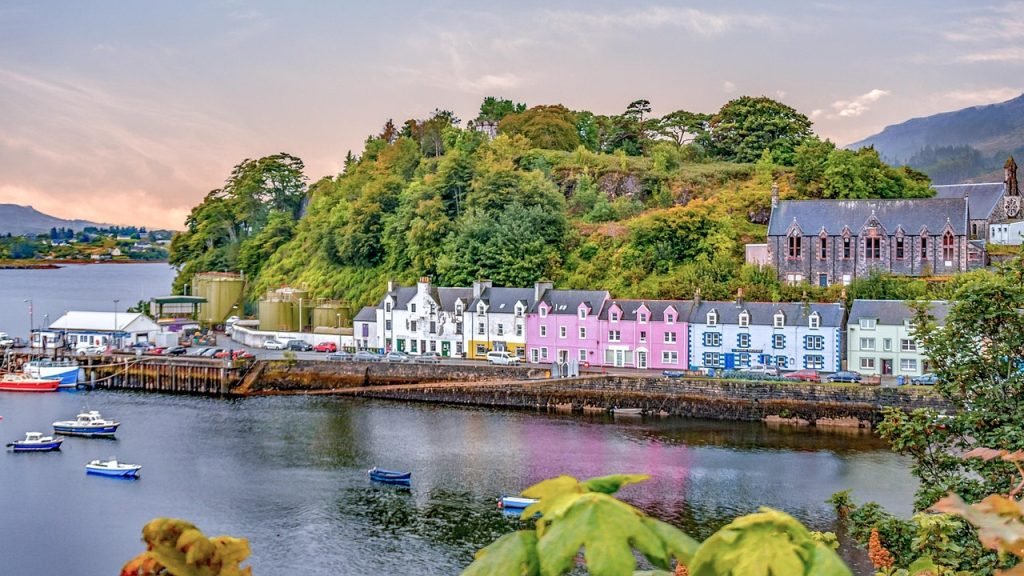
Portree serves as Skye’s largest town and main commercial center, offering visitors a perfect base for exploring the island. The town’s harbor area features the iconic row of colorful houses that appear on countless postcards and travel brochures, creating one of Scotland’s most photographed townscapes.
The town center provides essential services, shops, restaurants, and accommodation options, while maintaining its traditional Highland character. The harbor walks offer peaceful strolls with views across the Sound of Raasay, while the Scorrybreac Circuit provides a longer walk with panoramic views of the town and surrounding landscape.
Key Attractions: Colorful harbor houses, local shops, restaurants, and galleries.
Services: Banks, shops, restaurants, accommodation, and tourist information.
Harbor: Working fishing port with scenic walks.
Events: Various Highland Games and cultural events throughout the year.
Practical Planning for Your Skye Adventure
Best Time to Visit: May through September offers the warmest weather and longest daylight hours. July and August are the peak season, surely no doubts. These months also bring crowds and higher prices. April and October can provide excellent weather with fewer tourists. Winter visits offer dramatic stormy skies and the possibility (rare) of Northern Lights.
Getting There: The Skye Bridge connects the island to the mainland at Kyle of Lochalsh. Alternatively, ferries operate from Mallaig to Armadale and from Glenelg to Kylerhea (summer only, small car ferry).
Getting Around: A car is essential for exploring Skye effectively. The island has single-track roads with passing places, so allow extra time for journeys. Fuel stations are limited, so fill up when possible.
Weather Considerations: Skye’s weather can change rapidly. Always carry waterproof clothing and warm layers, even in summer. Check weather forecasts and tide times for coastal walks.
Accommodation: Book well in advance, especially for summer visits. Options range from luxury hotels and historic castles to cozy B&Bs and camping sites. Wild camping is legal in Scotland under the Right to Roam, but follow Leave No Trace principles.
What to Pack: Waterproof jacket and trousers, warm layers, camera with extra batteries, and a good map or GPS device.
Final Thoughts: The Spell of Skye
Here’s the truth about the Isle of Skye: it gets under your skin in ways you don’t expect. You might arrive as a casual tourist, camera in hand, dutifully ticking off the famous landmarks. But somewhere between your first glimpse of the Old Man of Storr and that moment when you’re standing at Neist Point watching the sun paint the Atlantic, something shifts. You realize you’re not just visiting a place. You’re experiencing something that will fundamentally change how you think about landscape, about what it means for a place to feel truly wild.
The practical reality is that you should plan for at least two to three days to properly experience Skye’s highlights—and that’s if you’re being efficient. But honestly, time becomes a bit fluid here, measured not in hours but in moments. The moment you first see the Quiraing emerging from morning mist, the moment you realize the Fairy Pools actually do look fairy-touched, the moment you understand why people have been making pilgrimages to this island for centuries.
You’ll leave Skye with a memory card full of photos that somehow never quite capture what your eyes saw, and with the certain knowledge that you’ll be back. Because that’s what Skye does—it plants a seed of longing that grows stronger with distance. Years later, when you’re stuck in traffic or dealing with the mundane frustrations of daily life, you’ll find yourself thinking about those impossible landscapes, those moments of pure wonder, and you’ll start planning your return to the Winged Isle. And trust me, when you do come back—and you will—it will be just as magical as you remembered, possibly more so. That’s the true sorcery of Skye: it never disappoints, only deepens its spell.