Krakow is Poland’s crown jewel, a city that survived World War II’s devastation to emerge as one of Europe’s most perfectly preserved medieval capitals. This isn’t just another pretty European city—it’s a living museum where cobblestone streets echo with centuries of history, where pierogi steams in candlelit restaurants, and where every church spire tells a story of resilience and renewal. From the haunting beauty of its Jewish Quarter to the underground wonders of ancient salt mines, Krakow offers layers of discovery that reward curious travelers with experiences both profound and delightful.
Getting to Krakow: Your Journey Begins
From Krakow Airport (KRK): Multiple Paths to the Heart of Poland
Krakow’s John Paul II International Airport sits about 15 kilometers west of the city center, and getting into town is refreshingly straightforward—when the weather cooperates.
The Winter Reality Check Here’s what many travel guides won’t tell you: Krakow Airport is notorious for winter fog delays and cancellations. The airport’s location in the Vistula River valley creates perfect conditions for dense fog from November through February, sometimes grounding flights for hours or even days. If you’re traveling in winter, build flexibility into your schedule, pack essentials in your carry-on, and consider travel insurance. The fog typically lifts by mid-morning, but early morning and evening flights are most affected.
Transport Options: Finding Your Way
Option 1: Airport Bus 209/300 (Most Economical) The city bus system offers the cheapest route to the center. Bus 300 runs every 20 minutes to the old town, taking about 30-40 minutes and costing just 6 PLN (about €1.5). Bus 209 serves a similar route with slightly different stops. Consider bus 902 as night line, similar route. Buy tickets from machines at the airport or use the mobile app—conductors check frequently and fines are steep.
Option 2: Airport Express Train (Fastest) The rail connection to Kraków Główny takes just 18 minutes and costs 20 PLN (about €5). Trains run every 30 minutes during peak hours, less frequently in the evenings. It’s the quickest option but requires a short walk from the airport terminal to the train platform.
Option 3: Taxi/Uber/Bolt (Most Convenient) Official airport taxis charge approximately 80-120 PLN (€17-25) to the city center, depending on traffic and destination. Uber/Bolt is typically 20-30% cheaper and more transparent with pricing. The journey takes 20-40 minutes depending on traffic, with morning and evening rush hours significantly longer.
Option 4: Private Transfer (Comfort Choice) Pre-booked private transfers cost 100-150 PLN (€20-32) and offer door-to-door service with meet-and-greet. They’re particularly valuable if you’re arriving late, traveling with luggage, or want to avoid potential language barriers.
When to Visit: Krakow Through the Seasons
Spring (March-May): Renaissance Awakening Spring in Krakow is magical but unpredictable. March can still be cold and gray, but April and May bring blossoming trees, comfortable temperatures, and fewer crowds. This is ideal for walking tours and outdoor exploration, though pack layers for variable weather.
Summer (June-August): Peak Season Glory Summer delivers warm weather, long daylight hours, and vibrant street life. The Main Market Square buzzes with outdoor dining, street performers, and festivals. However, this is also peak tourist season with highest prices and largest crowds. Book accommodations well in advance.
Autumn (September-November): Golden Hour Early autumn offers perhaps the best Krakow experience—warm days, cool evenings, beautiful fall colors, and manageable crowds. September and October are particularly lovely, with comfortable temperatures perfect for walking and exploring.
Winter (December-February): Atmospheric but Challenging Winter Krakow is atmospheric and cozy, with Christmas markets, snow-dusted architecture, and fewer tourists. However, days are short, weather can be harsh, and the airport fog situation makes travel unpredictable. If you visit in winter, embrace the indoor attractions and cozy restaurant culture.
What to See: Krakow’s Essential Experiences
The Heart of Poland: Main Market Square (Rynek Główny)
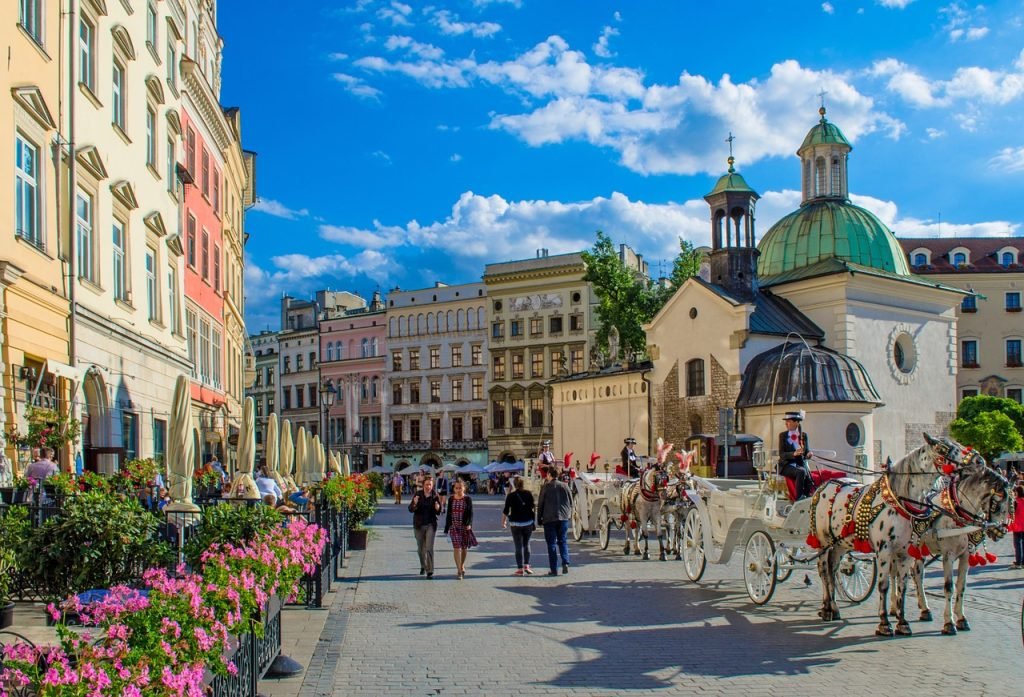
The largest medieval town square in Europe isn’t just a tourist attraction—it’s Krakow’s living room, where locals and visitors intersect in daily life. The 13th-century Cloth Hall (Sukiennice) dominates the center, housing souvenir stalls on the ground floor and an excellent gallery of 19th-century Polish art upstairs.
St. Mary’s Basilica anchors one corner with its famous trumpet call (Hejnał) played every hour from the taller tower. The call famously cuts off mid-note, commemorating a medieval trumpeter shot by Mongol invaders while warning the city. Inside, the wooden altarpiece by Veit Stoss is considered one of Europe’s finest examples of Gothic art. Tickets: 3.5€ (18 PLN)
The Underground Museum beneath the square reveals archaeological discoveries from Krakow’s medieval past. This isn’t just dusty artifacts—it’s an immersive journey through 1,000 years of city life, with interactive displays and atmospheric lighting that brings history to life.
Wawel Castle: Poland’s Crown Jewel
Perched above the Vistula River, Wawel Castle served as the royal residence for 500 years and remains Poland’s most important historical site. The castle complex includes the Royal Castle, Wawel Cathedral, and beautiful Renaissance courtyard. Don’t miss the dragon statue! It spits fire every 10 minutes (when not undergoing maintenance).
The Royal Apartments showcase period furniture, tapestries, and artwork that illustrate Poland’s golden age. The highlight is the collection of 16th-century Flemish tapestries, among the finest in Europe.
Wawel Cathedral has witnessed the coronations and burials of Polish kings for centuries. The royal tombs, including those of national heroes like Józef Piłsudski, make this Poland’s Westminster Abbey.
Pro tip: Buy tickets (about 12€) online in advance, especially for summer visits. The castle limits daily visitors to preserve the historic interiors. The courtyard is free and beautiful in spring and summer. It could be enough if you are tight on budget.
Kazimierz: The Jewish Quarter’s Complex Story
Kazimierz tells two stories—the vibrant Jewish community that flourished here for 500 years, and the tragic destruction of that community during World War II. Today, it’s experiencing a renaissance as Krakow’s bohemian cultural district.
The synagogues, small, simple and basic, can be visited in a short time. They are disappointing value for money, especially if you don’t understand English or Polish. It is best to visit them with a local guide as part of a tour of the Kazimierz district. If you loved the film Schindler’s List, you can find several locations from the film.
The Old Synagogue (Stara Synagoga) is now a museum documenting Polish Jewish history and culture. The adjacent Remuh Synagogue still serves the small contemporary Jewish community, with its atmospheric cemetery containing Renaissance-era tombstones.
Szeroka Street forms the heart of the historic Jewish quarter, lined with synagogues, Jewish restaurants, and cultural centers. The street comes alive during the annual Jewish Culture Festival in summer.
Modern Kazimierz has evolved into Krakow’s hippest neighborhood, with independent galleries, vintage shops, craft cocktail bars, and restaurants that blend traditional Polish cooking with contemporary creativity.
Schindler’s Factory: Confronting History
The museum in Oskar Schindler’s former factory presents the story of Krakow during World War II through immersive exhibits that personalize the Holocaust experience. Rather than focusing solely on Schindler, the museum examines how ordinary people responded to extraordinary circumstances.
The museum doesn’t shy away from difficult truths about collaboration, resistance, and survival. Interactive displays and personal testimonies create an emotional journey that’s educational without being exploitative.
Those expecting a museum focused on Schindler may be disappointed, as the main focus is on World War II. There are no audio guides, and knowledge of English is required.
Important note: This museum requires advance booking with queues that could last several hours. Allow 2-3 hours.
Day Trips: Exploring Beyond Krakow
Auschwitz-Birkenau Memorial: A Necessary Journey
Located 70 kilometers from Krakow, the Auschwitz-Birkenau Memorial and Museum preserves the site of Nazi Germany’s largest concentration camp. This isn’t tourism—it’s pilgrimage to honor the memory of over one million victims.
The uncomfortable truth: Even this sacred place has become Instagram-ized. Tour buses arrive packed with tourists taking selfies, souvenir shops sell magnets and keychains, and the profound silence is broken by casual chatter. The commercialization of this memorial is deeply troubling.
We recommend a different approach. Come here not for photos or social media content, but to truly understand this crucial chapter of human history. Resist the tourist trap mentality. This is about bearing witness, learning, and ensuring “never again” means something real.
Our advice: Visit Birkenau instead of Krakow’s alternatives. Rather than spending time at Schindler’s Museum and Kazimierz’s synagogues—now crowded tourist attractions—dedicate that time to Birkenau. The vastness of this site, its preserved barracks and ruins, offers a more profound understanding of the Holocaust’s magnitude than any museum display ever could.
The experience will challenge you, change you, and stay with you long after you leave. It should.
Getting There:
Practical advice: Book online well in advance (free entry but timed slots required), bring photo ID, and prepare for airport-style security screening. Allow a full day for the complete experience.
Wieliczka Salt Mine: An Underground Cathedral
Are we in the Lord of the Rings dwarf mines? Even better! Like stepping into the fabled mines of Moria, but bathed in crystalline beauty rather than shadow, the Wieliczka Salt Mine beckons adventurers into its ancient depths. Just 15 kilometers from Krakow, this underground realm reveals chambers that would make even the dwarven lords of old pause in wonder—a subterranean cathedral of salt carved by human hands across seven centuries.
Here, beneath the Polish earth, lies a UNESCO World Heritage site where salt has been the kingdom’s treasure for over 700 years. The miners who toiled in these depths were not merely extracting white gold—they were crafting a testament to human artistry that rivals the greatest halls of Middle-earth.
The Tourist Route descends 135 meters underground, passing through 20 chambers carved from salt rock. The highlight is the stunning Chapel of St. Kinga, a cathedral-sized chamber with chandeliers, altars, and religious sculptures all carved from salt.
Getting There:
Entry: around 150 PLN for adults, 120 PLN for students. The 3-hour tour involves considerable walking and climbing stairs, so wear comfortable shoes.
Tatra Mountains: Poland’s Alpine Adventure
We have to admit – this is one we couldn’t fit into our itinerary, and it remains one of our biggest regrets. But we’d be remiss not to mention this incredible opportunity waiting just beyond Krakow.
The Tatra Mountains, about 2 hours south of Krakow, offer Poland’s most dramatic mountain scenery. The resort town of Zakopane serves as the gateway to hiking trails, cable car rides, and traditional highland culture – an adventure that clearly deserves its own dedicated trip.
Zakopane: This mountain resort town is famous for its wooden architecture, traditional highland culture, and access to Tatra National Park. The pedestrian-friendly Krupówki street offers regional specialties like oscypek (smoked sheep cheese) and local crafts.
Gubałówka Hill: A funicular railway leads to this viewpoint offering panoramic views of the Tatra peaks. In winter, it’s a popular skiing area; in summer, it’s perfect for hiking and mountain biking.
Morskie Oko: Poland’s largest mountain lake requires a 2-hour hike but rewards visitors with stunning alpine scenery. The trail is well-marked and suitable for moderate fitness levels.
Getting There:
Practical Krakow: Making the Most of Your Visit
Getting Around the City
Krakow’s historic center is compact and walkable, with most major attractions within 20 minutes of each other on foot. The city’s excellent public transport system includes trams and buses that connect the center with outer districts.
Public Transport: Day passes cost 15 PLN and cover all trams and buses. The mobile app (jakdojade) helps navigate routes and schedules. Trams are generally more convenient for tourists than buses.
Taxis and Ride-Sharing: Uber and Bolt operate throughout the city with transparent pricing. Traditional taxis are metered, but always ensure the meter is running.
Where to Eat: From Pierogi to Fine Dining
Krakow’s food scene has evolved dramatically, blending traditional Polish cuisine with international influences and modern techniques.
Traditional Polish: Try pierogi (dumplings) at Przystanek Pierogarnia, or hearty meat dishes at Pod Aniolami. Milk bars (bar mleczny) offer authentic, budget-friendly Polish meals.
Modern Polish: Restaurants like Copernicus and Cyrano de Bergerac elevate traditional recipes with contemporary presentation and ingredients.
Budget tip: Lunch specials at many restaurants offer the same quality as dinner at significantly lower prices.
Accommodation: From Historic to Hip
Old Town: Maximum convenience but highest prices and potential noise from nightlife.
Kazimierz: Bohemian atmosphere with excellent restaurants and bars nearby.
Podgórze: Quieter residential area across the river with good transport connections.
Budget options: Hostels in renovated historic buildings offer charm at backpacker prices.
Luxury: Historic hotels like Hotel Copernicus provide royal treatment in medieval settings.
Cultural Etiquette and Practical Tips
Language: English is widely spoken in tourist areas, but learning basic Polish phrases is appreciated.
Currency: Polish złoty (PLN). Most places accept cards, but carry some cash for markets and traditional establishments.
Tipping: 10-15% in restaurants if service charge isn’t included.
Shopping: Galleries and boutiques in Kazimierz, traditional crafts in the Cloth Hall, modern shopping centers outside the historic center.
Safety: Krakow is generally very safe, but use common sense in tourist areas and at night.
The Honest Verdict: Why Krakow Deserves Your Time
Krakow isn’t trying to be Prague or Vienna—it’s confidently Polish, with its own distinct character shaped by triumph and tragedy, tradition and innovation. The city offers something increasingly rare in European travel: authenticity without pretense, history without stuffiness, and culture without the crushing crowds that plague other medieval capitals.
The day trip opportunities add tremendous value, allowing you to experience Poland’s most important historical sites, natural wonders, and cultural experiences all from one base. Few cities offer such easy access to UNESCO World Heritage sites, mountain adventures, and profound historical education.
What to expect: A city that rewards curiosity, respects history, and embraces visitors without losing its soul. Krakow is large enough to offer sophisticated culture and cuisine, yet small enough to navigate easily and feel intimate.
What might challenge you: Winter weather unpredictability, emotional weight of historical sites, and the need to book popular attractions in advance.
The bottom line: Krakow offers one of Europe’s best value propositions for cultural travel, combining stunning architecture, rich history, excellent food, and reasonable prices in a city that feels both timeless and vibrantly alive.
Whether you’re drawn by medieval architecture, Jewish heritage, wartime history, or simply the charm of cobblestone streets and cozy restaurants, Krakow delivers an experience that’s both educational and deeply moving. It’s a city that doesn’t just show you Poland’s past—it helps you understand Poland’s present and future.