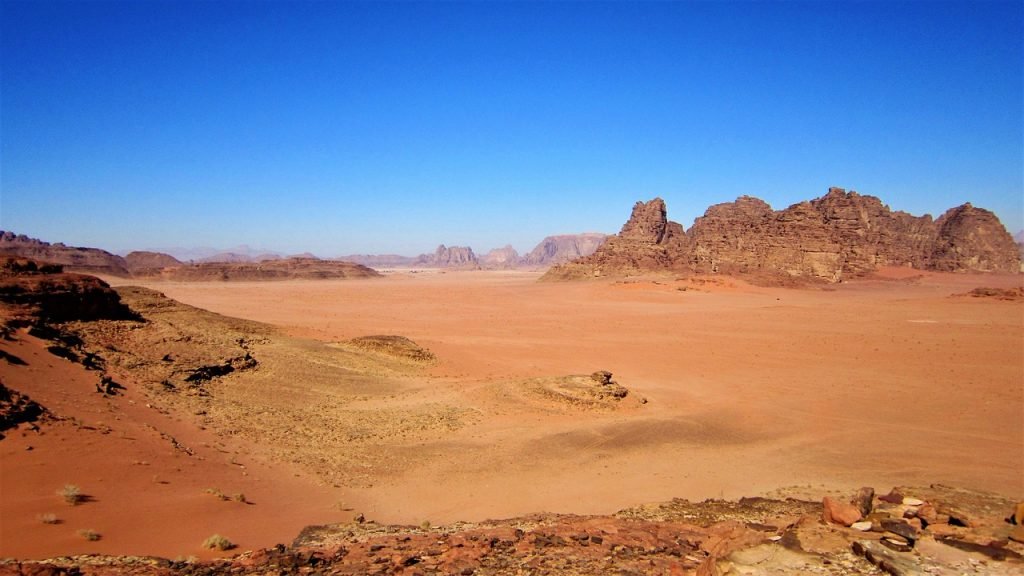
Imagine standing beneath a canopy of stars so brilliant you can practically reach out and touch the Milky Way, surrounded by towering red sandstone cliffs that glow like embers in the desert twilight. Welcome to Wadi Rum, Jordan’s most spectacular desert wilderness – a place so otherworldly that filmmakers chose it to represent Mars itself.
Known as the “Valley of the Moon,” this UNESCO World Heritage site spans over 720 square kilometers of dramatic landscapes that have remained virtually unchanged for millions of years. It’s where Lawrence of Arabia once roamed, where ancient Nabataean traders carved their stories into rock faces, and where modern travelers discover that sometimes the most profound journeys happen when you simply stand still and look up.
Why Wadi Rum Looks Like Another Planet
Wadi Rum was chosen as the filming location for multiple Martian movies, and once you see it, you’ll understand why. The towering sandstone and granite mountains, some reaching heights of 1,750 meters, were sculpted by wind and water over 500 million years into formations that seem almost extraterrestrial. The desert floor, covered in red sand that shifts from deep burgundy to pale pink depending on the light, creates a color palette that changes dramatically throughout the day.
The geological diversity here tells an epic story. Natural arches, narrow canyons called “siqs,” and mushroom-shaped rock formations dot the landscape, while ancient petroglyphs cover many rock faces – testament to the civilizations who recognized this place as sacred.
Getting to Wadi Rum: Your Journey to the Desert
I strongly recommend traveling to Wadi Rum by car, as this gives you complete flexibility and control over your schedule.
From Amman (320km, 4-5 hours): Take the Desert Highway (Route 15) south toward Aqaba. The road is well-maintained and clearly marked. Exit at the Wadi Rum junction about 60 kilometers before Aqaba, then drive 7 kilometers to the Wadi Rum Visitor Center.
From Petra (100km, 1.5-2 hours): A shorter drive through stunning desert scenery – many travelers create the perfect Jordan triangle: Amman, Petra, and Wadi Rum.
From Aqaba (60km, 1 hour): The shortest route, perfect for combining your desert adventure with time at Jordan’s Red Sea port.
Accommodation: The Heart of Your Desert Experience
Desert safaris depend heavily on accommodation, so choosing the right place to stay is absolutely crucial. I strongly recommend traditional Bedouin camps, as I did during my trip with my wife. We were almost alone at the camp, with a dedicated driver who guided us for more than 4 hours through the desert, and we enjoyed easy-going planning while negotiating the price in advance.
Traditional Bedouin Camps (Highly Recommended):
- More authentic cultural experience
- Better stargazing with minimal light pollution
- Located within the real Wadi Rum protected area
- Excellent value with negotiable pricing
- Dedicated guides with deep desert knowledge
Luxury Desert Camps (Proceed with Caution):
While some luxury camps might look good for Instagram photos, they are often less authentic and frequently located outside the real Wadi Rum area, where you’ll encounter light pollution that diminishes the legendary stargazing experience.
Important Safety Note: Be aware of desert animals during the night, so it’s always best to choose established traditional Bedouin camps rather than camping completely alone under the stars. Solo camping is only recommended for people with at least some camping experience.
Desert Safari Highlights: What You Must See
A comprehensive Wadi Rum desert tour should include these spectacular locations:
Natural Wonders:
- Lawrence’s Spring: A natural water source where T.E. Lawrence reportedly refreshed himself during the Arab Revolt
- Khazali Canyon: A narrow siq with ancient petroglyphs covering its walls that you can walk through
- The Natural Bridge: A stunning rock arch that you can climb for panoramic desert views
- The Mushroom Rock: A geological formation sculpted by wind erosion into a distinctive mushroom shape
- Red sand dunes: Experience the iconic Martian-like landscape and try sandboarding
- Jebel Rum: The highest peak offering spectacular panoramic views of the entire protected area
Historical and Cultural Sites:
- Anfishieh Inscriptions: Ancient Nabataean and Thamudic inscriptions carved into rock faces
- Traditional Bedouin culture: Learn about local customs, desert survival techniques, and enjoy authentic zarb meals cooked underground
Best Photography Spots:
- Sunset and sunrise viewpoints: Witness breathtaking colors across the desert from elevated positions
- Golden hour locations: The warm light enhances the red sandstone colors dramatically
- Night sky photography: Some of the world’s best astrophotography conditions
Adventures in the Desert
Camel Trekking: For a traditional desert experience, camel trekking offers a slower, more contemplative way to explore Wadi Rum. These gentle giants provide a rhythmic, swaying journey that connects you to centuries of Bedouin travel traditions. Be prepared though – camels smell quite bad! Despite the odor, treks can range from one-hour experiences to multi-day adventures and remain an authentic way to experience the desert.
4WD Desert Safaris: The classic Wadi Rum experience involves guided tours through the desert’s most spectacular locations, typically lasting 2-4 hours with knowledgeable Bedouin drivers.
Rock Climbing and Hiking: The sandstone formations offer excellent opportunities for all skill levels, from beginner-friendly scrambles to challenging technical climbs.
The Star-Filled Desert: World-Class Stargazing
When the sun sets over Wadi Rum, the real magic begins. The lack of light pollution, combined with high altitude and exceptionally clear air, creates stargazing conditions that are simply breathtaking. On a clear night, you can see the Milky Way stretching across the sky like a cosmic river, with stars appearing so bright and numerous that constellations become challenging to identify.
The astronomical experience becomes even more profound during new moon phases. Many traditional camps offer telescopes and astronomy guides, while Bedouin storytellers share traditional tales about the stars passed down through generations of desert dwellers.
Practical Information
Best Time to Visit:
- March to May & September to November: Ideal weather with warm days and cool nights
- December to February: Can be surprisingly cold at night but offers excellent stargazing
- June to August: Extremely hot during the day, though nights remain pleasant
Entry Requirements: Permits are required and available at the Visitor Center (typically 7 JOD for international visitors, included with Jordan Pass).
What to Pack: Layers for temperature changes, sun protection, comfortable hiking shoes, flashlight, camera with extra batteries, and warm clothing for surprisingly cool nights.
Conclusion: Your Desert Adventure Awaits
Wadi Rum offers more than spectacular photographs or thrilling adventures – it provides a transformative experience in one of Earth’s most extraordinary landscapes. Whether you’re drawn by pristine stargazing, desert adventures, or authentic Bedouin culture, this remarkable place offers experiences that will stay with you forever.
The silence of Wadi Rum speaks louder than any city’s noise. The vastness puts daily concerns into perspective. The brilliance of its night sky reminds us of our place in the universe. Choose traditional Bedouin camps, travel by car for maximum flexibility, and prepare for a journey that connects you not just with an incredible landscape, but with the eternal rhythm of desert time itself.
In Wadi Rum, you don’t just visit the desert – you become part of its timeless story.